Monday, January 27, 2014

Genesis 7: Art is a Computer Angel

Vayetze/Went away (Genesis 28:10-32:3)

He [Jacob] had a vision in a dream. A ladder was standing on the ground and its top reached up toward heaven; and behold! Divine angels were ascending and descending on it. (Genesis 28:12)

We enjoyed sitting together in the Metropolitan Museum of Art print room holding Rembrandt's drawings and etchings of angels in our hands.
Mel painted on subway posters and screen printed digitized Rembrandt angels and spiritual messages from underground:

Divine angels ascend and descend. (Genesis 28:12) "They start by going up and afterwards go down" (Rashi) "Have you seen angels ascending from the NYC subways? (Alexenberg)
Art is a computer angel.  The biblical term for art (MeLekHeT MakHSheVeT) is feminine.  The masculine form is computer angel (MaLakH MakHSheV).

The biblical words for angel and food are written with the same four letters to tell us that angels are spiritual messages arising from everyday life.
We chose an image of an ascending angel to digitize and send on a circumglobal flight on 4 October 1989, Rembrandt's 320th memorial day.  

We sent it via satellite from the AT&T building in NY to Amsterdam to Jerusalem to Tokyo to Los Angeles, returning to NY the same afternoon.
The cyberangel not only circled our planet, it flew into tomorrow and back into yesterday, arriving in Tokyo on 5 Oct. and LA on 4 Oct.

In Tokyo, the 28 faxed sheets were assembled in Ueno Park and then rearranged as a ribbon ascending the steps of a Shinto chapel.
As we assembled the cyberangel on its return to NY five hours after it had left, TV news sent it into ten million American homes.

The AP story of our angel flight appeared in 60 newspapers each with a different headline.  AT&T featured it in its Annual Report.
For the full story and more images, see artworks at http://www.melalexenberg.com. 

Genesis 8: The Spirit of Amalek in Germany

Vayishlah/Sent (Genesis 32:4-36:43)

Rescue me, please, from the hand of my brother, from the hand of Esau, for I fear him lest he come and kill us all, mother and children alike…. Jacob went to Sukkot….  Esau was the ancestor the Edomites.  (Genesis 32:12,17,43)
Remember what [the Edomite tribe] Amalek did to you on your way out of Egypt.  When they encountered you on the way and struck those of you who were weak and lagging behind when you were weary and exhausted. (Deuteronomy 25:17,18)


The spirit of Amalek rises up in every generation to murder Jews because they are Jews from the time of the Exodus to the Persian Haman.
And to the Spanish Inquisition to the Russian pogroms to the Holocaust orchestrated by Hitler with Germany efficiency.

Arising once more in Persia today as Iran develops nuclear weapons to wipe Israel off the map.
Germany is promoting a second Holocaust by doing billions of dollars’ worth of business with Iran despite international sanctions.

The week of Vayishlah, Mel was keynote speaker at a symposium on Postdigital Narrative Art at Germany's ZKM Center for Art and Media.
Mel's presentation focusing on this blog was presented in a huge building that was formerly Hitler's torpedo factory in Karlsruhe.

In the 1200's, Munich's Jews were herded into the synagogue and burnt to death.  In the 1700's, Munich authorities made it illegal to build a sukkah.
For Sky Art '83, Mel built a sukkah at the entrance to the BMW Museum in Munich that was attacked by a neo-Nazi motorcycle gang.

Although they failed to destroy the sukkah, they smashed the table holding earth from Israel that had cast its shadow on the sukkah floor.
The scattered earth was swept up.  Mel spread it on the grass at the site of Hitler's death camp in Dachau.

He wrote from multiple viewpoints the word sukkah with Hebrew letters constructed from rebar rods discarded at a building site.

Sunday, January 26, 2014

Genesis 9: Love and Respect

Vayeshev/Settled (Genesis 37:1-40:23)

A man found him blundering about….  The man asked, "What are you looking for?" "I am looking for my brothers" he replied. "Perhaps you can tell me where they are."  (Genesis 37:15,16)

Mel photographed his experience of Jerusalem's Central Bus Station passing through it on his way to teaching at Emuna College.
People rushing in all directions seem to be blundering about looking for their brothers and sisters without finding them.

In everyday Israeli speech, Jews often address each other as ahi (my brother). 
Can we find each other as ahi despite different backgrounds, lifestyles and viewpoints?

Miriam's brother Ezra and his sons-in-law wear the knitted kippot of religious Zionists that are sold in the bus station.
Her sister Channa's husband and their son and sons-in-law wear the black fedoras of Lubavitcher Hasidim.

On Shabbat, her brother Hans' sons and sons-in-law don the fur strimels of Belzer Hasidim.
They all love and respect each other.

Hanukah, the Festival of Lights that begins this week, teaches us to respect opposite viewpoints.
Shamai proposes lighting 8 candles on the first night, removing one each night until only one remains on the 8th day of Hanukah.

Hillel proposes lighting one candle each night until all 8 candles burn brightly on the last night of Hanukah.
Shamai's conceptual view makes logical sense since the full cruse of oil found for the Temple rededication was used up over the 8 days.

Hillel's aesthetic view teaches that it is more beautiful to add light to the world each day than removing it.

Genesis 10: From Hellenistic to Hebraic Consciousness

Miketz/Passed (Genesis 41:1-44:17) Hanukah

Then Pharoh said to Joseph, "See! I have placed you in charge of all the land of Egypt."  And Pharoh removed his ring from his hand and put it on Joseph's hand. (Genesis 41:41, 42)

In creating a weekly blog post, we often begin with a concept and then make the photographs. 
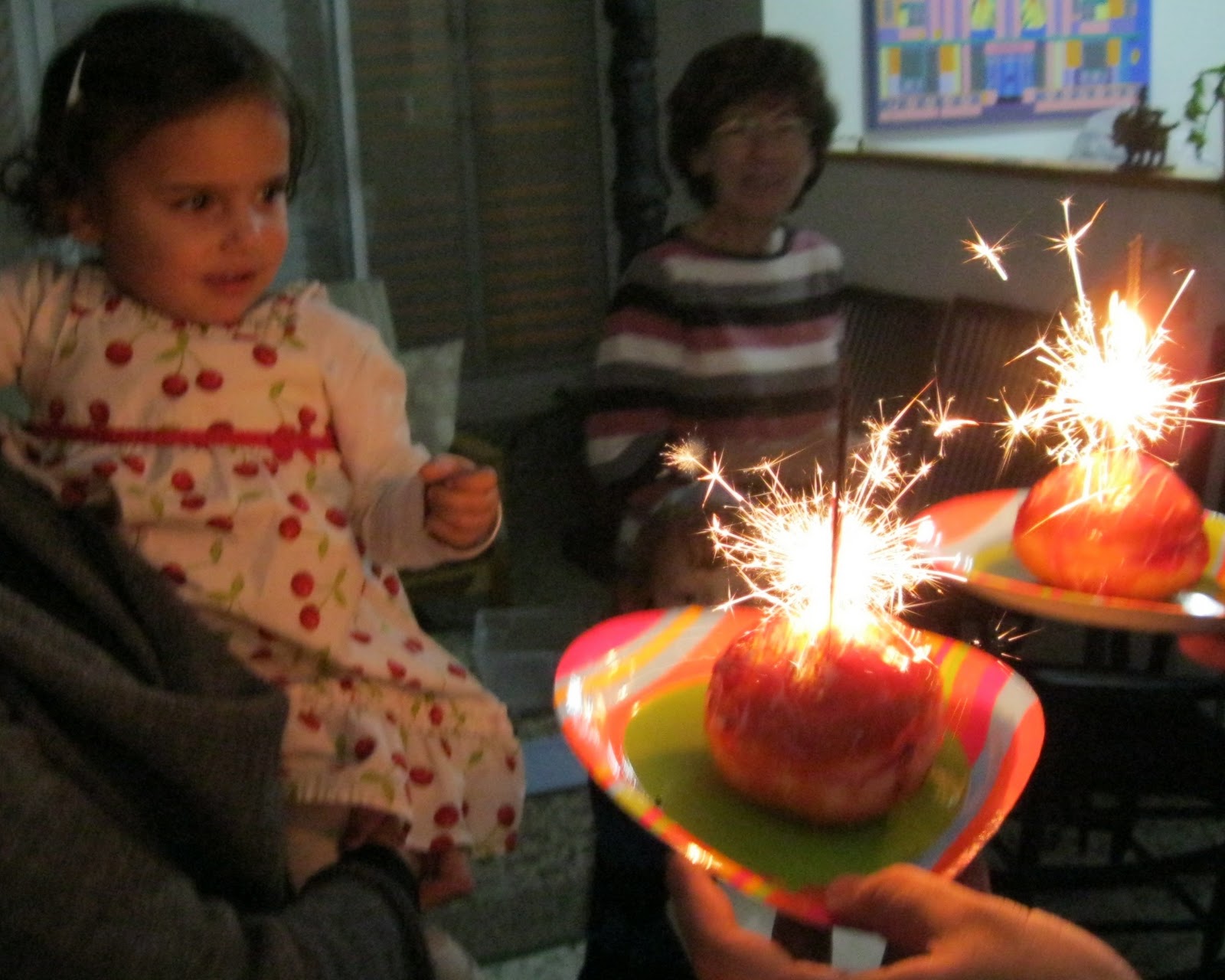
This week, the concept was derived from photographs of our family lighting both Hanukah and birthday candles.

Two other events in our lives this week related to Miketz and Hanukah contributed to this posting.
Rejoicing that Mel completed his book The Future of Art in a Postdigital Age: From Hellenistic to Hebraic Consciousness.

Rejoicing this Hanukah that the Greeks saved Jews by sending fire-fighting planes and firefighters to douse the Mt. Carmel forest fire.
The photographs show our grandson Yahel lighting olive oil wicks of a hanukiah in which light from outside is reflected inside.

Mel and our son Moshe lighting Hanukah candles in which light from inside is reflected outside.
Our grandchildren Tagel, Razel and Elianne dancing to the singing of Hanukah songs.

Elianne looking in awe at the candles and sparklers in two pink sufganiot  [jelly donuts] in celebration of her second birthday.
While retaining his Jewish consciousness, Joseph succeeded in the major culture of his day only to have his descendants enslaved to it.

Hanukah story:  Jews so enamored by Hellenistic culture that they would assimilate into it at war with those who chose to retain Jewish values.
Postdigital story:  A paradigm shift from Hellenistic static beauty in stone to Hebraic dynamic beauty of flickering flames and new media.

Genesis 11: No Longer a Lost Tribe

Vayigash/Approached (Genesis 44:18-47:27)

Joseph said to his brothers, "Please, come close to me." When they came close, he said, "I am Joseph your brother!"  (Genesis 45:4)


The reuniting of Joseph with his brothers after two decades of separation is the most emotionally charged portion of the Bible.
Bnei Menashe [Children of Manasseh] came to mind as we thought about our lives in relation to Joseph’s reuniting with his brothers.

Amazing news! Bnei Menashe, the descendants of Joseph’s son Manasseh, one of the Lost Tribes of Israel, is no longer lost.

They have been found living in northeastern India near the border with Burma.

Today, the children of Manasseh are reuniting with their family in the Land of Israel after a 27 century separation.

Throughout their long exile, they continued to observe the Sabbath, eat kosher food, and celebrate the biblical festivals.

A Google search for "Bnei Menashe" brought us to Shavei Israel (www.shavei.org) active in making this Zionist miracle come true.

Mel contacted its chairman Michael Freund who put us in contact with Tzvi Khaute who came on aliyah 10 years ago from India.

Tzvi shared photos of his son Yaacov's bar mitzvah celebration this Hanukah posted here.  On the bar mitzvah invitation, he wrote:    

And God said to Jacob [Yaacov], "Return to the land of your fathers and to your native land, and I will be with you."  (Genesis 31:3)

In next week's Torah portion Vayehi, Jacob blesses his grandson Manasseh.
 

Genesis 12: Home after 27 Centuries

Vayehi/Lived (Genesis 47:28-50:26)

Israel said to Joseph, "I never pilal-ti (thought/hoped/imagined/dreamed) that I would ever see your face again, and God has even let me see your children." (Genesis 48:11)
To this day, Jewish fathers bless their children with Jacob's blessing: "May God make you like Ephraim and Manasseh." (Genesis: 48:20)


We focus this Vayehi blog post on our awesome reunion with the beautiful children of the Children of Manasseh (Bnei Menashe) from India.
Tzvi Kahuate, Bnei Menashe Coordinator for Shavei Israel, was our guide on our visit to his community in Kiryat Arba.

Shavei Israel reaches out and assists Lost Tribes seeking to return to the Jewish people.
We photographed Tzvi with his daughter in purple (segol) and his wife Nurit with their youngest daughter as their Superman son watched.

Mel explained that the Jewish People are am segulah that can be translated as "purple people."
We are a People chosen to teach the world that by mixing sky blue with red (adom) of earth (adamah) we bring heaven down to earth.

We photographed Laviyah with her four-day old son and her son Menahem.  Her husband was away serving in the Israel Defense Forces.
We visited Beit Miriam, the Shavei Israel Community Center, where we saw Bnei Menashe children coming for help with their homework.

Others worked with computers and on crafts projects while two girls outside were climbing a tree.
At the entrance to Beit Miriam, the prophetic vision that we were seeing with our own eyes was posted on the wall:

And I will return the captivity of Judah and the captivity of Israel, and I shall assemble them as in the beginning. (Jeremiah 33)

Exodus 1: Herzl at a Herzliya Car Wash

Shemot/Names (Exodus 1:1-6:1)

And these are the names of the Children of Israel (Exodus 1:1)

We spent Shabbat Shemot (Names) in Herzliya named for Theodore Herzl, the towering figure of modern Zionism.
Driving to the hotel, we photographed a laser-cut steel portrait of Herzl at the entrance to Herzliya peering down on a car wash.

The banner on the water tower advertises the celebration of Herzl's 150th birthday and the founding of the city Herzliya 85 years ago.
We had lunch on the hotel patio overlooking the pool and sea. 

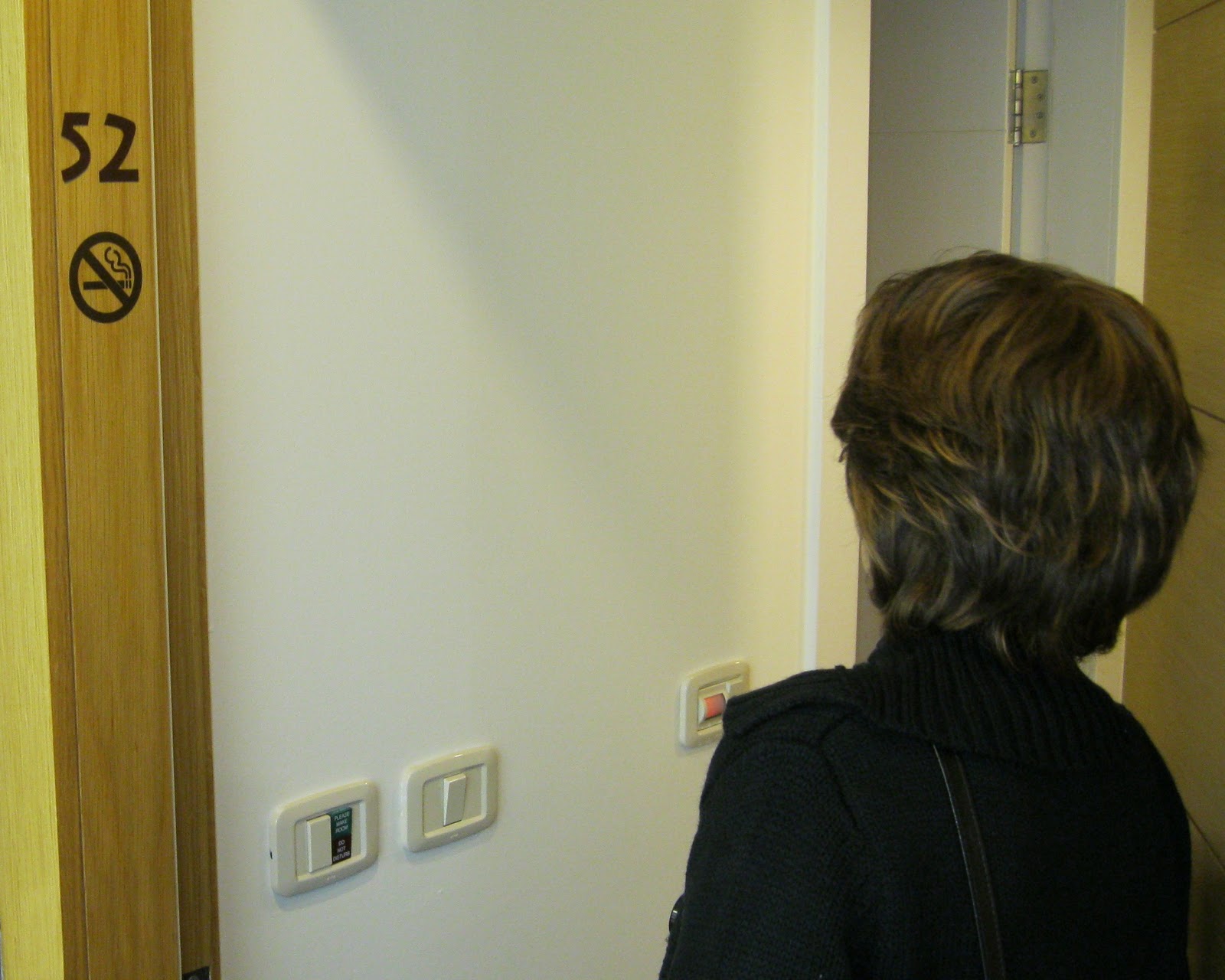
We felt all was going right when we were given the key to room 52 in celebration of the 52nd year of our marriage.
Miriam's mother lived at Beit Juliana, the Dutch parents' home in Herzliya, until she passed away two years ago at 102. 

As founder of the Dutch Zionist Organization and chief rabbi of Holland, Miriam's great-grandfather, Rabbi Yosef Tzvi Dunner, knew Herzl.
Mel's grandfather, Rabbi Shlomo Zalman Kahn, participated in the 4th Zionist Congress in London in 1900 chaired by Herzl.

Herzl imagined how the Jewish State would be in his 1902 utopian novel Altneuland (OldNewLand), titled Tel Aviv in its Hebrew translation.
The main character in Herzl's book arrives at the newly created Jewish State in a yacht from his exile on an isolated Pacific island.

We photographed the yachts at the Herzliya Marina and the Imaginarium shop in the Herzliya Marina Mall.
On Sunday, we went to the Tel Aviv port to buy a new light fixture for our dining room and had lunch at the water's edge.

Then I came to the exiles, to Tel Aviv…. and I dwelt where they were dwelling. (Ezekiel 3:15)